FRNYC schools may already be enrolled, or are considering enrolling, in other NYCPS programs, such as CTE, CRMYA, and/or CS4All. Below you will find details on how FRNYC connects with these other programs.
The goal is to ensure these efforts are not siloed, but aligned and integrated to deliver a comprehensive and equitable student support system—one that weaves together quality career-connected instruction, work-based learning, personalized advising, personal finance, and early college credits and credentials for all students.
Career and Technical Education
Supporting FRNYC schools towards NYSED CTE Approval:
All FutureReadyNYC (FRNYC) schools that have earned designation and have identified an appropriately licensed CTE teacher and demonstrate readiness to meet the additional requirements of the NYSED CTE Program Approval Process, are encouraged and welcome to pursue New York State Education Department (NYSED) Career and Technical Education (CTE) program approval.
- FRNYC Designation as Readiness Indicator: Previously, schools relied on Key Implementation Milestones (KIMs) completion to gauge readiness to work towards NYSED CTE Program Approval Process.
- With the implementation of the formal FRNYC Designation process, starting SY 26-27, FRNYC Designation will serve as the official readiness indicator for entering the NYSED Program Approval Process (PAP).
- Core Readiness Bar: Designation confirms that a school has established the necessary systems and structures to deliver high-quality student experiences across the 5 FRNYC Pillars:
- Career-Connected Instruction (CCI)
- Work-Based Learning (WBL)
- Advising
- Personal Finance
- Early College Credits & Credentials
FRNYC to NYSED CTE Program Approval Progression
Schools enter the NYSED CTE Program Approval Process (PAP) upon earning FRNYC Designation and on confirmation of an appropriated licensed CTE teacher.
- Year 1: First-Year Implementation (building foundational structures).
- Year 2: Full Implementation (eligible for designation assessment).
- Year 3: FRNYC Designated Schools — CTE Program Approval Onboarding Process
- Invitation to Opt-In
- FRNYC schools that have earned active designation status will be invited to complete an official CTE Program Approval Opt-In Form in the Fall, immediately after designation status is confirmed. Interested designated schools must submit the form by the specified deadline.
- Preliminary Readiness Evaluation
- Following submission, the CTE team will evaluate the school’s preliminary readiness, including confirmation of an appropriately licensed CTE teacher as well as other requirements necessary to pursue NYSED CTE Program Approval. This readiness review will consider the school’s capacity and commitment to engage in the Program Approval Process, including the required curriculum and course sequence, work-based learning experiences, industry and postsecondary partnerships, technical assessment, and other documentation and program components required for CTE approval. This review will determine the school’s eligibility to begin working directly with the Program Approval and Quality (PAQ) team in the Fall immediately following designation.
- Confirmation & Next Steps
- If the CTE PAQ team confirms the school has met preliminary readiness for supports toward the Program Approval Process, the school will be cleared to receive direct technical assistance, coaching, and resources to initiate their CTE Program Approval application, provided active year over year FRNYC designation status is maintained.
A few considerations:
- FRNYC coursework is already crosswalked with NYSED Career Development and Occupational Studies (CDOS), NYS Next Generation Learning Standards and The Common Career Technical Core (CCTC). Such crosswalking is a required component in the development of a 7+ credit NYSED approvable CTE program of study
- The FRNYC Personal Finance Component may count towards the Career and Financial Management requirement for CTE programs of study, so long as this component is delivered by a CTE-certified instructor
- With some modifications, the FRNYC Credential of Value may count as the Technical Assessment requirement for NYSED CTE Endorsement
- By State law, an appropriately licensed CTE instructor must deliver CTE instruction. See here for more information related to teacher certification
- See here for additional considerations for FRNYC schools planning to develop a 7+ credit CTE program of study and seeking NYSED Approval.
- By State law, an appropriately licensed CTE instructor must deliver CTE instruction. An updated document with information related to teacher certification, is due to publish soon. We will add it here when available.
For additional information, including for schools with FRNYC and CTE programs that have already been approved, please reach out to Adam Breier, Deputy Executive Director of CTE.
Computer Science Education
The Computer Science Education Team (CSE) will work closely with FRNYC schools launching technology pathways in Data Science and Software Development to support Career-Connected Instruction (CCI). Teachers from schools implementing these pathways will have the opportunity to participate in optional year-long PL provided by the Computer Science Education team focusing on curriculum options for courses 1 and 2 of the pathway course sequence.
Schools launching Cybersecurity pathways will be invited to participate in intro level computer science training through CSE. CSE will support the first course in the sequence, Introduction to Computer Science, but the remaining courses and credentials will be supported by the central FRNYC team in partnership with an outside vendor like CompTIA.
All FRNYC Technology Pathways teachers will be invited to optional CSE organized Communities of Practice focusing on additional computer science and emerging tech topics as well as pedagogy-focused sessions to support classroom implementation.
Note: CTE certified instructors must now also possess the CS SOCE or CS All grades cert to provide FRNYC instruction in the Technology pathway in addition to their CTE certification. Effective 9/1/24.
FutureReadyNYC: Integrating NYC Reads and NYC Solves to Accelerate Student Success
As we launch the 2026–27 school year, FutureReadyNYC (FRNYC) stands alongside NYC Reads and NYC Solves as a central pillar of our district’s equity and readiness strategy. These three initiatives share a common purpose: to ensure every student—especially those furthest from opportunity—graduates with strong literacy and numeracy skills, a clear postsecondary plan, and access to real economic opportunity.
FutureReadyNYC pathways are built on math- and literacy-intensive sectors like healthcare, technology, and business. That means academic recovery and acceleration—especially in Grades 9 and 10—is foundational to success in career-connected learning. High-impact practices from NYC Reads and NYC Solves (such as Strategic Reading Periods and supplemental math blocks) are key levers to support student readiness and close learning gaps before 11th grade.
Math: Make Time to Succeed
Why this matters:
Algebra 1 is a proven gateway to postsecondary success—but many students enter high school with math skills several grade levels behind. NYC Solves math curricula are rigorous and engaging, but they often require more time than a standard class period allows.
District Recommendation:
Provide at least 2 supplemental math periods per week—and up to 10 total periods for students with significant learning gaps.
Supplemental math time enables schools to:
- Finish full lessons without rushing
- Build fluency through strategic practice
- Deliver targeted intervention for students below grade level
Implementation Tip: Use data to tailor your approach
- 5%+ of students need support → Extend math time for all
- <25% need support → Target small-group interventions
- 25–75% need support → Mix of whole-class extension and targeted support
Scheduling Options
- Extended blocks: Add time directly after core math
- Split blocks: Schedule support elsewhere in the day
Reading: Build a Schoolwide Reading Culture
Why this matters:
Strong readers are strong learners. To boost reading outcomes, every high school should implement consistent, designated time for reading intervention, support and enrichment.
District Recommendation:
Program consistent, designated time for reading intervention, support, and enrichment, 4+ days/week, especially for students reading below grade level. Use multiple measures (screeners, diagnostics, curriculum-based assessments) to group and target supports.
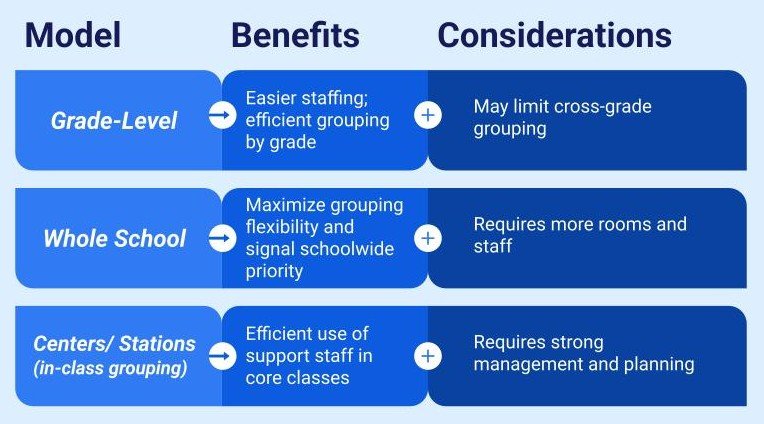
Intervention Scheduling Models:
Putting It All Together: Math, Reading, and FutureReadyNYC
To close foundational skill gaps and unlock career-connected learning, schools should aim to provide:
- 7–10 periods/week of math support
- 4–5 periods/week of reading support
- FutureReadyNYC periods for career development, personal finance, career-connected instruction, and other postsecondary readiness experiences
That’s up to 16–20+ instructional periods per week focused on core skills and postsecondary readiness for students who need them most.
We recognize that no school has unlimited time, staff, or space. A helpful planning approach is to begin by mapping out the full set of recommended instructional periods—math, reading, and FutureReadyNYC—and determining how many 9th and 10th grade students need to be programmed for each. From there, schools can work backward from the ideal—where every student receives the right supports—and make informed, values-aligned tradeoffs based on available resources like staffing, schedule, and space. The goal is a coherent school model grounded in equity, aligned to district priorities, and responsive to the needs of your students and community.